IV Sedation vs Oral Sedation vs Nitrous
2026-09-09
The appointment isn't the problem. You could handle the appointment — if you didn't have to be there for it. That's the part nobody says out loud: it's not the drill, it's being awake, aware, and stuck in the chair while it happens. So you've been reading about sedation dentistry, and now you're stuck on a different question: IV sedation vs oral sedation vs nitrous oxide — which one is enough?
Getting that answer wrong has a cost in both directions. Choose too light, and you white-knuckle through the visit anyway — and the fear walks out stronger than it walked in. Choose deeper than you need, and you've arranged a driver, written off a day, and paid for depth you didn't want.
Here's what each level actually does, where each one stops, and how to tell which one fits you.
How deep does each sedation level go?
Sedation isn't one thing. It's a range — from softening the edge of anxiety to remembering almost nothing about your visit.
Nitrous oxide: awake, present, calmer
You breathe nitrous oxide through a small mask that rests over your nose. Within a few minutes, the anxiety loosens its grip. You stay awake and aware — you can answer questions and follow what's happening — but the fear stops running the room. When the mask comes off, the effect fades within minutes, and most patients are cleared to drive themselves home.
Oral sedation: a pill before you arrive
Oral sedation is a prescribed medication you take before your appointment. By the time you're in the chair, you're drowsy and deeply relaxed. Many patients are only loosely aware of time passing, and some doze lightly through their procedure. The medication works in your system for hours, so you'll need a ride both ways and a slow rest of the day.
IV sedation: the deepest of the three
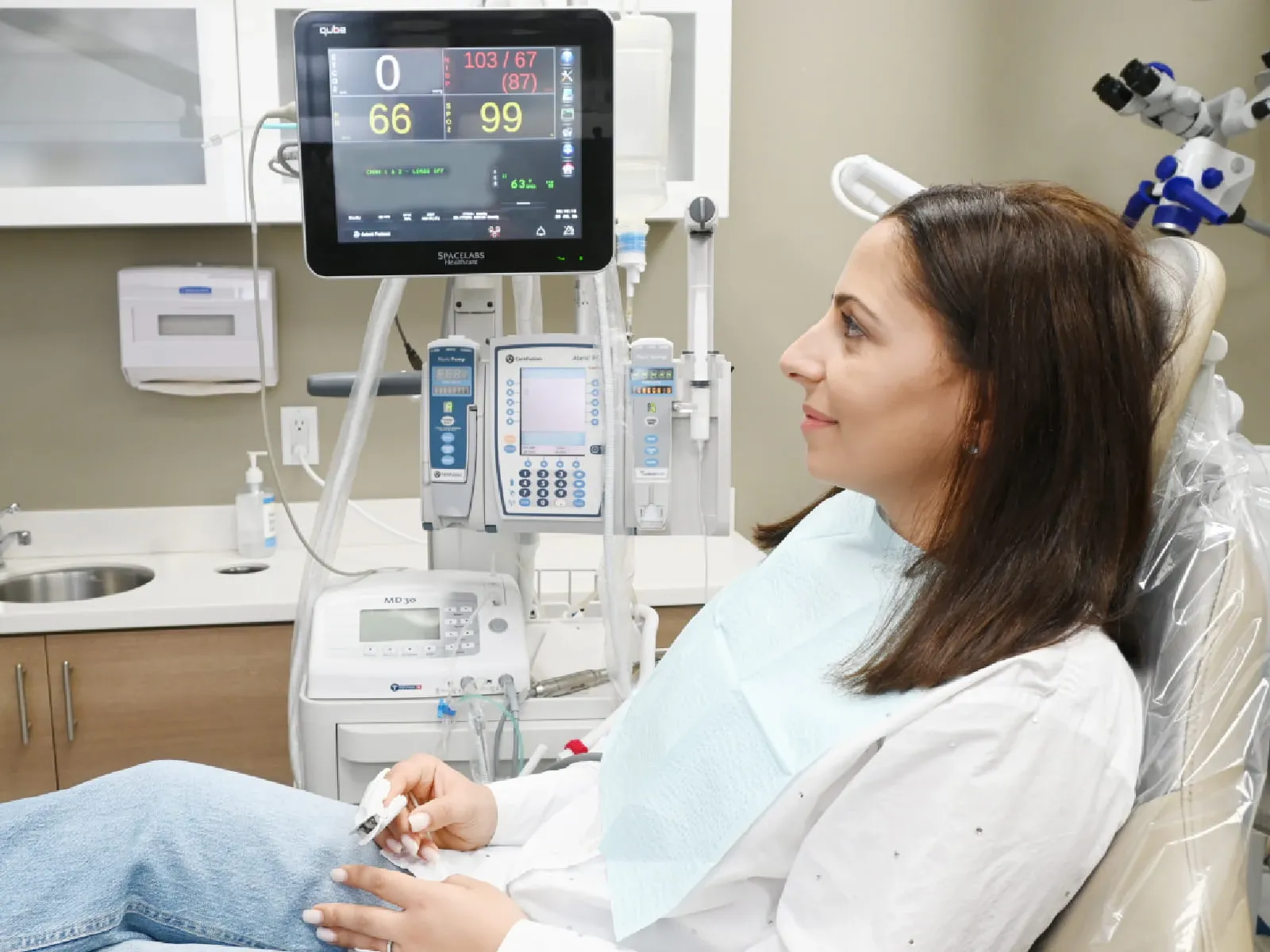
IV sedation delivers medication directly through a vein, so it takes effect within minutes. You're not unconscious. You keep breathing on your own, and you can respond if we speak to you. But most patients remember very little of the appointment afterward. One of our patients put it this way: the visit "felt like 5 minutes." You'll need a driver, and we'll give you specific instructions before the appointment, including when to stop eating and drinking.
IV sedation vs oral sedation: what's actually different
Both go well beyond taking the edge off, so patients often assume they're two versions of the same thing. They're not.
The first difference is control. A pill is a single dose, taken in advance — whatever it does is what it does. IV medication can be adjusted in real time as your procedure goes on. If the work runs long, the sedation keeps pace with it.
The second is monitoring. During IV sedation, an infusion pump controls the dose precisely. Your vital signs — heart rate, oxygen, blood pressure — are watched the whole time.
The third is memory. Oral sedation leaves most patients loosely aware of the visit. IV sedation leaves most patients remembering almost none of it. If years of avoidance are what brought you here, that difference is usually the one that matters.
At Viva Smile, IV sedation is the option we recommend for surgical work (dental implants page), for longer procedures, and for patients whose fear runs deep enough that staying aware isn't something they want.
Where nitrous fits — and where it stops
Nitrous suits mild anxiety and shorter visits. It's the only option that lets you get on with your day — no driver, no recovery window. If you want the edge taken off without giving up the afternoon, this is the option built for that.
Where it stops: you're fully present the entire time. For patients whose anxiety is the reason they've stayed away, present is exactly what they don't want to be. Taking the edge off a deep fear still leaves most of the fear.
IV sedation vs oral sedation vs nitrous: what each costs
At Viva Smile: nitrous oxide is $600, oral sedation is $150, and IV sedation is $1,600 — flat, no matter how long your procedure runs.
You'll notice oral sedation costs less than nitrous even though the relaxation runs deeper for most patients. The fees reflect what each option involves to deliver, not a ranking of which works better.
The word "flat" on IV sedation matters. The convention in dentistry is to bill IV sedation by the clock — a fee for the first stretch, then an added charge for every 15 minutes after. That means the bill grows while you're sedated, in no position to weigh anything. We decided against that. The number you hear at your consultation is the number on your treatment plan.
One more thing: sedation is generally not covered by dental insurance, which is part of why we price it flat. The full pricing picture, including when IV sedation is included at no separate charge, is here: sedation dentistry page
How to choose — and what can change the answer
As a general guide:
- Mild anxiety, shorter visit, want your day back: nitrous oxide.
- Deeper relaxation, and you can arrange a ride: oral sedation — it does more than most patients expect, at the lowest fee of the three.
- Long or surgical procedure, or you'd rather remember almost none of it: IV sedation, the option we recommend most.
Two things can change that answer. Some health conditions and medications shift which options are open to you. We review your full medical history and every medication you take before any sedation is planned. And if the needle itself is the fear, say so. For injections we use The Wand, a computer-controlled system that delivers anesthetic at a slow, steady rate. Most patients who've dreaded shots their whole lives are surprised by it.
Dr. Baghdasaryan trained in IV sedation at the USC Herman Ostrow School of Dentistry and has been a member of the American Dental Society of Anesthesiology since 2008. He also serves as an examiner for Dental Board of California Anesthesia Unit. The depth of sedation you choose is up to you. The safety of it isn't left to chance at any level.
You don't have to decide this alone
Which level fits you isn't a menu question — it depends on the procedure, your health history, and how deep the fear actually runs. That's a conversation, and it starts with a dental exam: $150, covered in full by most PPO plans, no lecture attached. You'll leave knowing where things stand and which options make sense for you. When you're ready: booking page
Written by Dr. Káren Baghdasaryan, DDS, MBA, AAACD, AFAAID — the first DSD-certified clinician in Los Angeles.